
The Longer Version
The short version's on my homepage. Here's the rest.
I grew up in Detroit, went to Boston University, and spent my twenties directing TV shows — House Hunters, $40 a Day with Rachael Ray, a hundred others. I was good at it. I liked the live shoots, the pressure, the moment when everything's happening at once and somehow you have to hold it all together.
Then the industry changed, I moved around a lot, and somewhere in the middle of a failed marriage and a job search that went nowhere, I walked into an improv class in Portland. Everything shifted.
HOW I GOT HERE
From Blue Man Group to Google
That improv class led to clown training, which led to sketch comedy, which led to getting listed on Cirque du Soleil’s performer database and performing with Spiegelworld on an international tour - and then to Blue Man Group firing me after a month of training in New York. Which, it turns out, was one of the best things that ever happened to me professionally.
Getting fired by Blue Man Group when you're forty-something, in a city where you know almost nobody, is clarifying. I spent a lot of time thinking about failure, performance, and what it actually means to be present with an audience. I wrote a book about it. Seth Godin recommended it. I still can't quite believe that part.
Meanwhile, I'd started teaching — first improv and sketch, then public speaking, then communication skills for technical teams. In 2019, Google brought me in as a contractor, and I spent the next six years building and delivering programs for engineers, program managers, designers, and researchers. I trained over 3,000 people. The classes consistently sold out.
The work I'm most proud of from that period is my Technical Program Manager Meeting Facilitation Bootcamp — a program I built around live role-plays using fictional contexts like Star Trek and Hogwarts, because people learn interpersonal skills better when the stakes are imaginary. Program managers at Google, Netflix, and Uber went through it and said some pretty amazing things.
WHAT I ACTUALLY BELIEVE ABOUT THIS WORK
Practice beats theory
Most communication problems aren't knowledge problems. People know what a good meeting looks like. They've read the books. They just haven't practiced the hard parts in a low-stakes environment where it's safe to fail.
That's what I try to create. Not a performance. Not a polished presentation about presentation skills. An actual container where people can try something, get real feedback, and try again — and maybe laugh a little along the way.
The clown training turned out to be directly relevant to all of this. What clown teaches, at its core, is how to be fully present, how to recover from failure without collapsing, and how to connect with people without pretending to be someone else. Those happen to be the same skills that make a good program manager, a good presenter, and a good person to be in a meeting with.
I don't believe in transformational breakthroughs that happen in one session. I believe in practice, repetition, honest feedback, and showing up consistently. That's what changes behavior. That's what I try to offer.
THE LESS PROFESSIONAL STUFF
The rest of it
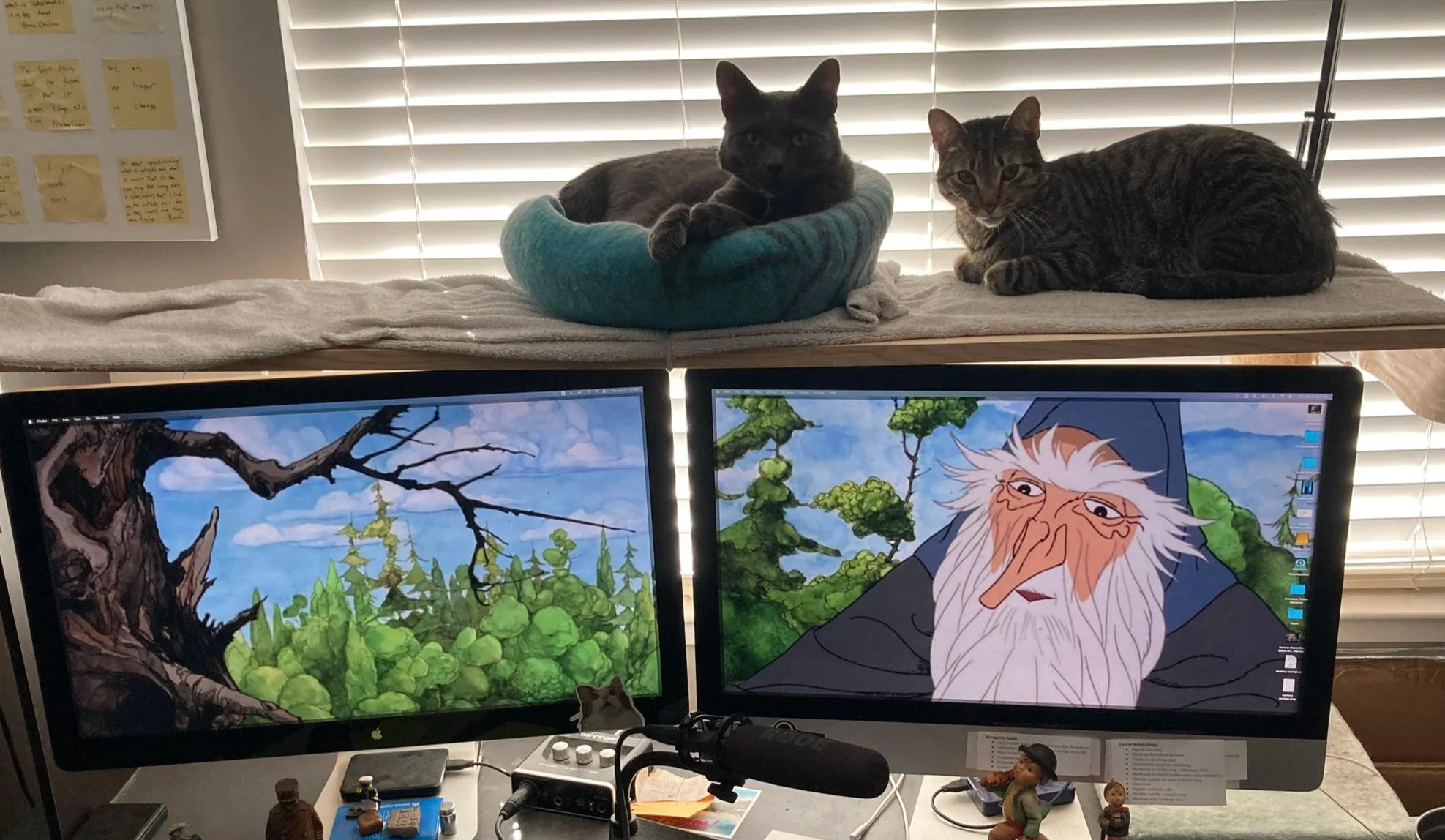
I live in Redwood City with my partner Tannis and our two cats, Tuna and Rigby. I have a birdfeeder I take unreasonable pride in. I'm currently reading something long and absorbing - like Lonesome Dove.
I go to the Russia-style sauna (210 degrees F) more than is probably financially advisable. It works every single time, so I keep going.
I've done over ten years of personal recovery work focused on family-of-origin patterns and it shows up in how I think about safety and risk-taking in a room. I volunteer at a hospice and cat shelter. I teach improv to local folks and senior citizens at a nearby community center. These are genuinely the best parts of my week.
I play drums badly and am getting less bad. I've been playing D&D badly for years. I once won a LA Fringe Award for best physical theatre, which remains one of my proudest professional achievements even though most people have no idea what it is.
IF YOU'RE THINKING ABOUT WORKING TOGETHER
Let's talk
The people I work with best are the ones who already know communication matters and are ready to actually practice, not just read about it. Technical teams, program managers, people who are brilliant at their jobs and want to be better at the human parts.
If that sounds like you or your team, I'd love to talk.